“You have completed your management research paper. But how do you know which journal is actually right for it?”
Completing your research paper is quite an accomplishment. The choice on how you will get it published is the next significant step.
A lot of authors share the same mistake. They do not take the time to check if the journal they want to publish in is relevant to their research. They just search for a high-ranking journal and submit their research.
But it is always a better move if you take into account the ABDC journal list and then consider the journal’s focus, scope, recent publications, quality, indexing, and institutional policies.
A Simple Journal Selection Process
Think of journal selection as a step-by-step journey rather than a race toward the highest ranking.
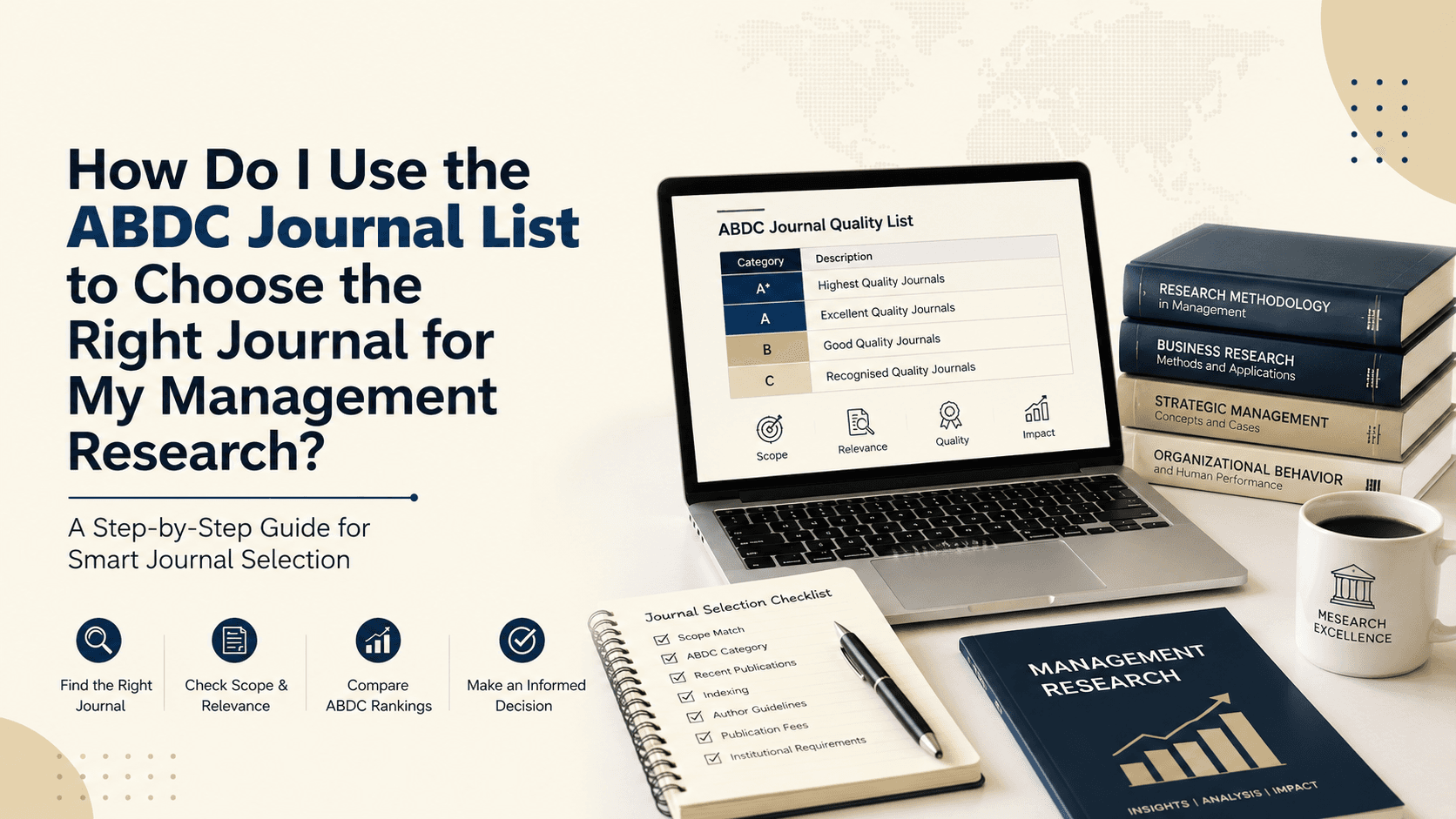
Australian Business Deans Council (ABDC) Journal Quality List is one of the tools that may be used when evaluating scholarly journals in the context of business and management research. Journals ranked into A*, A, B, and C. This ranking system can be beneficial for a researcher who wants to evaluate the status of a particular journal in his/her area of expertise. Nevertheless, ranking of a journal is not the sole criteria you should consider. Review by ABDC has also taken into account the quality of journals, classification, new inclusion, exclusion, and issues related to potential predatory journals. The review of 2025 was the last major review done after 2019. Therefore, one should check the most recent available data before using any old list or spreadsheet. Before searching for journals, look closely at your own paper. Imagine your research studies how transformational leadership affects employee performance in Indian IT companies. Your research may connect with: Human resource management Leadership Organisational behaviour Employee performance Management Information systems This gives you a much better starting point than simply searching for an A* journal. Once you know your research area, look at the ABDC journal ranking. The categories provide a useful indication of how journals are positioned within their respective fields. A higher category does not automatically mean a better choice for your manuscript. For example, an A* journal focusing mainly on financial markets may be unsuitable for a study about employee motivation. A lower-category journal with an excellent subject fit could be a more sensible target. The question is not: “Which journal has the highest category?” It is: “Which suitable journal gives my research a realistic opportunity to be read, reviewed, and published?” After identifying potential journals, read their aims and scope carefully. Then look at several recently published papers. Ask yourself: Does the journal publish research similar to my work? Does it use similar research methods? Does it publish studies from my subject area? Would its readers be interested in my findings? Does my research contribution fit the journal? This is one of the most effective methods of minimizing the chances of rejection at the desk. Even if a journal is ranked highly in some list, your research may still be out of scope for its audience. Do not select one journal and immediately submit. Create a shortlist of three to five relevant ABDC management journals. A simple structure can make the decision easier: Then compare the journals using the same criteria. This turns journal selection into a practical decision instead of guesswork. You may come across the term ABDC indexed journals while searching for publication options. It is important to understand that ABDC and Scopus are not the same system. A journal can appear in both systems, but one does not automatically guarantee the other. If your university requires both ABDC and Scopus, verify both independently. The ABDC Journal Quality of a publication is useful information, but it does not guarantee that your paper will be accepted. Editors and reviewers also consider: Originality Research question Theoretical contribution Methodological strength Data quality Writing quality Journal fit Practical or academic contribution This is why researchers should avoid choosing a journal only because it has an impressive label. Not necessarily. ABDC A journals* are highly competitive. They can be excellent targets for research that has strong originality, methodology, theoretical contribution, and a very close subject fit. The same principle applies to ABDC A journals. A strong A journal can be an excellent choice when its readership and scope closely match your research. ABDC B journals can also be appropriate when they meet your institutional requirements and provide strong subject alignment. Similarly, ABDC C journals should not automatically be dismissed. Their suitability depends on your publication objective and the rules that apply to you. Your target should be ambitious but realistic. Finding a journal is only half the job. You should also verify it. Check: Exact journal title ISSN Publisher Current ABDC status Subject or field classification Official journal website Peer-review policy Other indexing claims Publication fees Your university's current requirements This is especially important when you find a journal through an unofficial list, social media post, advertisement, or old PDF. Never assume that a claim about indexing or ranking is correct simply because it appears on a website. If you are wondering how to publish in ABDC journal, the process should begin with journal selection rather than at the final submission stage. First, identify suitable journals. Then study their recent articles and author guidelines. Secondly, organize your manuscript according to the journal’s requirements. This includes the manuscript’s format, referencing style, word count, figures, tables, ethical considerations, and submission process. Finally, proofread the manuscript to ensure that all requirements have been met. Lastly, submit through the official channel of the journal and get ready for editing, peer review, and finally a decision. There is no shortcut at all to get accepted. Choosing Only based on category alone: A good ranking will not compensate for journal suitability. Based on an old list: Status and categories may vary. Check the most up-to-date information. Considering that ABDC equals Scopus: These are independent systems that serve different purposes. Neglecting the latest issues: Latest papers tell you what the journal is publishing now. Selecting journals out of your discipline: Your paper requires the appropriate readership and not just a prestigious name. Not considering your institution’s guidelines: Your institution may require certain policies to be met. Before submitting your management research, ask: Does the journal match my research topic? Does its scope fit my study? Have I checked recent papers? Is the category suitable for my requirements? Have I verified the ISSN and publisher? Have I checked other indexing requirements? Have I checked publication fees? Have I read the author guidelines? Does the journal meet my institutional rules? Is this a realistic target for my manuscript? If you can confidently answer “yes” to most of these questions, you have a much stronger basis for submission. The ABDC journal list should be treated as a researcher's starting point, not a shortcut. Begin with identifying your research topic. Identify journals that have published research in this field. Evaluate them on the basis of their categories, scope, recent publications, guidelines, and submission policies. Shortlist them and select the journal which gives you the best match for relevance and credibility. It does not always mean that the best journal is the highest-ranking journal. It may well be the one in which your research belongs. Frequently Asked Questions How do I select an ABDC journal for management research? Think of your research topic and scope first, then compare the category, recently published articles, methods used, indexing, submission costs, institutional requirements, and fit for submission Is an A* journal always the best choice for researchers? No. A* journals are highly competitive, but strong topic fit, research quality, audience relevance, institutional requirements, and realistic acceptance expectations should guide selection. Is there any relationship between ABDC and Scopus as a publication system? No, ABDC gives journal quality classifications, and Scopus is an abstract and citation database used to index research publications. Do researchers receive assistance in selecting appropriate ABDC journals? Yes, professional publication services such as Writerr Publication Services can assist researchers to evaluate the suitability of journal scope, manuscript preparedness, formatting standards, submission guidelines, and publishing objectives prior to publication. What should I check before submitting my paper to an ABDC journal? Check the current status, category, ISSN, publisher, scope, peer review process, indexing, publication fees, author instructions, recently published papers, and institutional requirements before submission.
What Is the ABDC Journal List?
Step 1: Start With Your Research Topic
Match the journal with your research area
Research area Topics you may find in relevant journals Marketing Consumer behaviour, branding, advertising, digital marketing Finance Banking, investment, financial markets, corporate finance Human Resources Leadership, employees, talent, workplace behaviour Strategy Competitive strategy, firms, business performance Accounting Auditing, reporting, management accounting Operations Supply chain, logistics, productivity Entrepreneurship Start-ups, innovation, entrepreneurial activity Topic fit should come before ranking.
Step 2: Understand the ABDC Ranking
Category Simple meaning What researchers should consider A* Highest category Highly competitive and selective A Strong category High-quality research outlet B Established category Recognised publication option C Listed category May be suitable depending on requirements Step 3: Check the ABDC Journal Category and Journal Scope
Step 4: Build a Shortlist
Journal option Purpose Ambitious Strong fit but highly competitive Target Good fit with realistic expectations Backup Suitable alternative if your first choice does not work Factor What to check Research fit Does the journal publish your topic? Category Does it meet your requirements? Recent papers Are similar studies being published? Methodology Does the journal accept your approach? Audience Will your research interest its readers? Fees Are publication charges manageable? Timeline Does the publication schedule suit you? Institutional rules Does it meet your university's requirements? Step 5: Do Not Confuse ABDC With Scopus
ABDC Scopus Journal quality list Abstract and citation database Strong focus on business-related disciplines Multidisciplinary Uses A*, A, B and C categories Does not use the ABDC category system Helps assess journal standing Helps with indexing and citation visibility Step 6: Look Beyond the Ranking
What should you check before submitting?
Check Why it matters Journal scope Confirms research relevance Recent publications Shows current interests ISSN Confirms the exact journal Publisher Helps verify journal identity Peer review Shows how manuscripts are evaluated Publication fees Prevents unexpected costs Indexing Confirms additional requirements Author guidelines Helps avoid formatting problems Institutional rules Confirms academic eligibility Should You Always Choose an A* Journal?
How to Verify a Journal Before Submission
How to Publish in an ABDC Journal
Common Mistakes to Avoid
Final Checklist
Final Takeaway