For medical researchers, teachers, and postgraduate students, publishing their work in an appropriate and well-indexed journal is crucial. But in addition to finding out about the scope and the publication time frame of the journal, researchers have to confirm if its indexing satisfies the requirements of the relevant National Medical Commission (NMC).
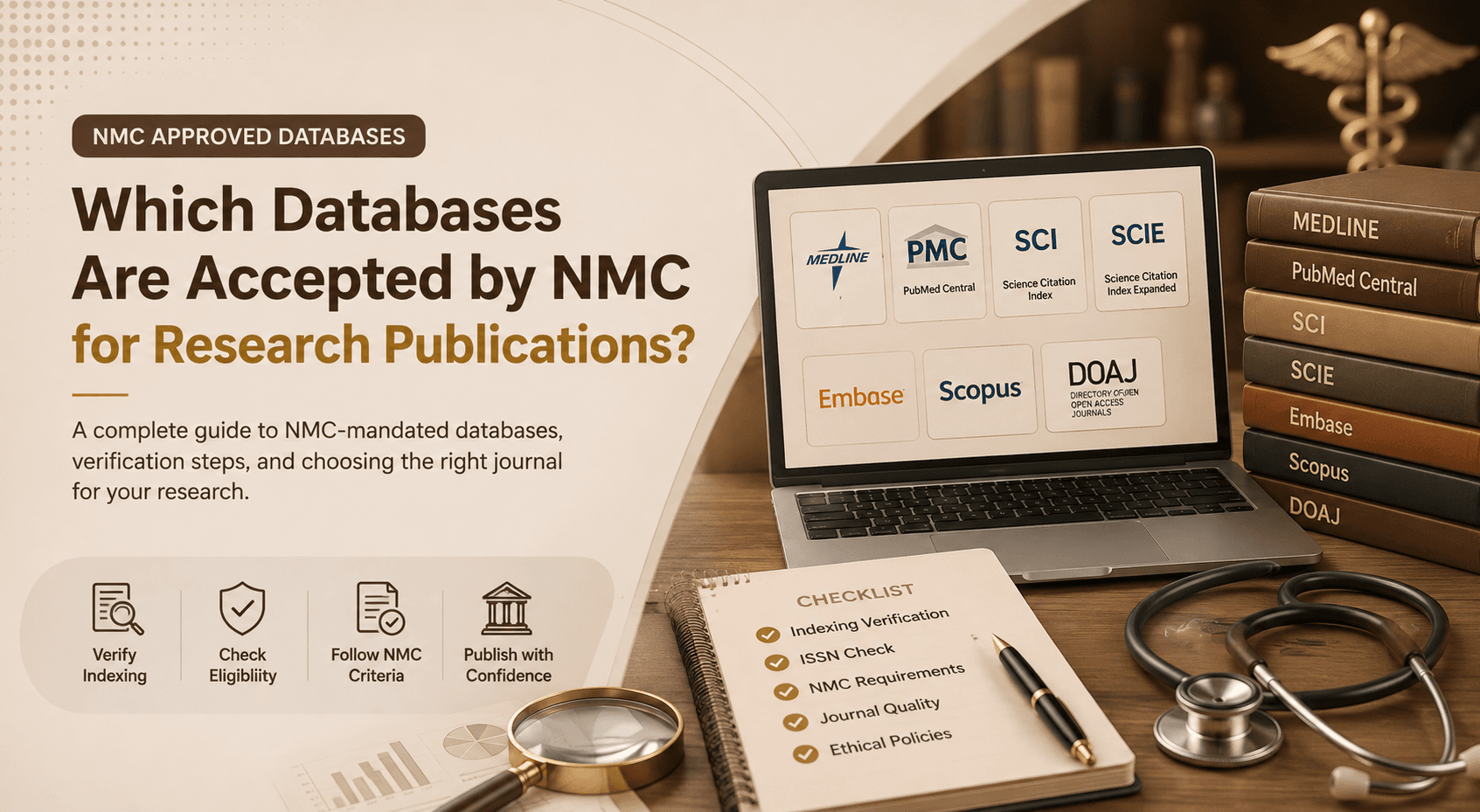
The list of databases required by the NMC, according to certain criteria of research publication, includes Medline, PubMed Central, Science Citation Index, Science Citation Index Expanded, Embase, Scopus, and DOAJ.
It is important to understand that "NMC approved databases" does not mean that every journal is separately approved by the NMC. Researchers should understand the difference between database indexing and NMC eligibility and verify the latest applicable requirements before submitting their research.
What Does NMC Mean by an Accepted Database?
In order to explain the individual databases, it is first necessary to clarify the definition of “NMC accepted databases.”
A research database or indexing service gathers and makes available scholarly materials through bibliographies, abstracts, full texts, citations, and research metrics.
When NMC regulation refers to certain databases, the journals listed in such databases can be considered when it comes to the specific criterion for research publication or assessment which is referred to in the regulation.
However, it does not imply that each of the journals listed in such databases is individually approved by NMC.
For instance, a journal might be indexed in Scopus, but the researchers need to make sure whether it has been indexed in Scopus and whether Scopus is recognized by the NMC regulation applicable to them.
The same principle applies to other databases.
It is useful to distinguish between three concepts:
- Database indexing: The journal is included in a particular scholarly database.
- Journal quality: The journal is compliant with proper editorial, peer review, and publication ethics policies.
- Eligibility for NMC requirement: The publication meets the necessary requirements for the particular NMC regulation or assessment criterion.
Though both terms can be related to each other, yet they are different from one another.
The NMC guidelines pertinent to this subject matter include the following journals: Medline, PubMed Central, Science Citation Index, Science Citation Index Expanded, Embase, Scopus, and DOAJ.
Thus, scientists must not rely on only the journal's statement that it is “NMC approved databases.” Rather, the indexing of the journal must be checked first via the relevant database and then the recent NMC requirements applicable to their case.
It must be noted that the rules of NMC can vary depending on time. What was stated in one guideline as a requirement does not have to be the current NMC requirement. Thus, researchers must check the current NMC publication guidelines before any decision-making.
Databases Mentioned by NMC
Several databases accepted by NMC for research-publication and assessment purposes. Each database has a different purpose, scope, and method of indexing.
1. Medline
Medline is an example of a major bibliographic database that provides health information literature.
It has a broad coverage of the field of medicine and life sciences research and is commonly accessed by doctors, researchers, healthcare practitioners, and students.
One of Medline's major strengths is its structured coverage of biomedical research.
Researchers can use it to find literature related to diseases, treatments, medical procedures, healthcare, pharmacology, and various other areas of health science.
For medical researchers, publication in a journal indexed in Medline can provide valuable visibility among the academic and healthcare communities.
However, researchers should verify the journal's indexing status directly rather than assuming that every journal appearing in a medical search engine is indexed in Medline.
2. PubMed Central (PMC)
It is an online database for articles in full-text form in biomedical and life sciences journals.
The key point for researchers regarding PMC is that PubMed and PMC are two different things.
PubMed is basically a database that consists of various records from different sources such as Medline. PMC is a repository where full-text articles that satisfy certain criteria can be found.
The differentiation between these databases is especially significant while checking the indexing status of the journal.
A researcher can find a specific article in PubMed and conclude that the journal is included in PubMed Central. However, this statement may be wrong.
Thus, in case there is any particular requirement for PMC, a researcher needs to look for the presence of a journal in the PMC.
3. Science Citation Index (SCI)
Science Citation Index is a citation indexing system linked to the Web of Science system.
Unlike a basic literature search platform, citation indexes can help researchers understand how frequently published research is being cited and how scholarly work is connected across publications.
SCI has historically played an important role in scientific literature indexing and citation analysis.
For researchers, citation indexing can contribute to the discoverability and academic visibility of published research.
However, terminology surrounding Web of Science indexes can sometimes be confusing.
Therefore, researchers should check the exact index in which a journal is included rather than relying on a broad statement such as “Web of Science indexed.”
4. Science Citation Index Expanded (SCIE)
Science Citation Index Expanded, or SCIE, is just one of the numerous citation databases offered under the umbrella of Web of Science databases.
SCIE covers numerous areas of science and offers citation data on scholarly literature for researchers. It is frequently considered when researchers evaluate journal visibility, citation performance, and academic reach.
Researchers should nevertheless verify the exact indexing status of a journal through the relevant official source.
A journal stating that it is “Web of Science indexed” does not provide enough information by itself. Researchers should determine which Web of Science collection or index includes the journal.
This is particularly important when a specific academic or institutional requirement refers to a particular indexing service.
5. Embase
Embase is an electronic database that includes biomedical and pharmacological literature.
Embase offers extensive information on biomedical, pharmaceutical, drug and medical studies. Embase is very useful for scholars conducting systematic reviews and evidence-based research.
For researchers requiring detailed coverage of biomedical and pharmacological literature, Embase is extensively used.
For researchers in medicine, pharmacy, clinical research, and similar areas, Embase can be a good source of research visibility.
As with other databases, however, researchers should verify the journal's current Embase coverage rather than relying only on information displayed on the journal's website.
6. Scopus
Scopus is a large abstract and citation database covering research from numerous academic disciplines, including medicine and healthcare.
It is widely used for:
- Discovering academic literature
- Tracking citations
- Evaluating research output
- Monitoring journal performance
- Analyzing research trends
- Measuring academic visibility
This is because Scopus indexes a broad range of disciplines.
However, there is one thing that must be considered: it would be erroneous to think that any journal claiming to be Scopus indexed already enjoys permanent indexing status.
Journals may become discontinued from being indexed within a particular database and vice versa.
It is, thus, recommended for researchers to look for such journals within the original Scopus source and confirm its NMC indexed journals status before sending their manuscripts.
7. Directory of Open Access Journals (DOAJ)
Directory of Open Access Journals (DOAJ) is a digital directory of open access scholarly journals.
The Directory of Open Access Journals concentrates solely on the area of open access publications and aims to help researchers find journals where scholarly content is available for free.
It should be noted that DOAJ differs from other citation databases such as Scopus and Web of Science.
Whereas citation databases concentrate on the aspects of scholarly publications, citations, and research analytics, DOAJ concentrates on the process of locating and increasing visibility of quality open access journals.
Comparison of NMC-Mentioned Databases
Each database has its unique purpose within academic research. This table will provide a brief comparison that will be useful for researchers to understand their differences:
| Database | Primary Focus | Main Purpose |
|---|---|---|
| Medline | Biomedical and health sciences | Finding medical literature |
| PubMed Central | Full-text biomedical literature | Accessing full-text research |
| SCI | Scientific citation indexing | Citation tracking and research discovery |
| SCIE | Scientific and multidisciplinary research | Citation analysis and research visibility |
| Embase | Biomedical and pharmacological research | Medical and pharmaceutical literature searching |
| Scopus | Multidisciplinary research | Literature discovery and citation analysis |
| DOAJ | Open-access scholarly journals | Discovering open-access journals |
The databases might be covering the same journals but in no way are they synonymous. For instance, whereas Medline and Embase are predominantly focused on providing coverage to biomedical literature, Scopus has a multidisciplinary approach.
SCI and SCIE place great emphasis on citation indexing, and PMC is primarily for accessing full-text biomedical journals.
Therefore, researchers should not simply ask whether a journal is indexed. They should ask where it is indexed, whether that database is relevant to their NMC requirement, and whether the journal's current indexing status can be independently verified.
Does Every Scopus or PubMed Journal Qualify Under NMC?
The simple answer is “No”.
This is one of the most important points researchers should understand before submitting a research paper.
Being indexed in Scopus, PubMed, or other NMC recognized databases does not automatically mean that a journal is universally eligible for every NMC-related academic purpose.
The applicable NMC regulation or assessment framework determines the conditions under which a publication can be considered.
For example, NMC assessment-related documents have described research-publication criteria involving original research papers, meta-analyses, systematic reviews, and case series published in journals indexed in specified databases. Some criteria have also included authorship conditions, such as being among the first three authors or serving as the corresponding author.
This demonstrates that database indexing is only one part of publication eligibility.
Researchers should consider:
The applicable NMC regulation or assessment framework.
The database in which the journal is indexed.
The journal's current indexing status.
The type of article being published.
Authorship requirements, where applicable.
The publication period covered by the relevant rule.
Any additional institutional or academic requirements.
The next question is the distinction between the older NMC publication requirements and the contemporary NMC requirements. The regulatory framework has changed, and it would be incorrect for the researcher to make assumptions that the requirement described in an old article or website is relevant today.
The official section of the NMC's rules and regulations provides access to current regulatory documents such as the Medical Institutions (Qualifications of Faculty) Regulations, 2025.
Thus, a researcher who intends to use the publication for faculty qualifications or promotion, institution assessment, or any other purpose must consult the relevant NMC document.
In other words, the indexation in the official database may be a significant requirement, but it cannot be considered an automatic criterion for NMC eligibility.
How to Choose the Right Journal for NMC Research Publications?
Selecting an appropriate journal needs more than looking at the database name. Researchers need to look at the journal from various angles before sending their manuscript.
8. Check the Journal’s Indexing
First, one needs to find out if the journal is indexed in a particular database according to his/her NMC requirement.
It cannot be assumed from the journal website alone; one needs to search for the journal on the database using its correct name or ISSN.
9. Check the ISSN of the Journal
International Standard Serial Number (ISSN) assists in identifying the journal correctly.
It is vital because there can be two similarly named journals.
It must be ensured that the ISSN provided on the journal website matches the database record.
10. Current Indexing Status
There can be changes in the indexing status of a journal. The journal which was indexed in some database a few years ago might not be indexed now in the same database.
Hence, the researcher needs to check the current status before submitting the manuscript.
11. Check the Journal's Scope
A journal must be related to your topic of study. Check the objectives and scope of the journal and analyze the articles which have been published.
The journal which consistently publishes the type of research that you publish is always preferred over a journal chosen just because it is indexed.
12. Analyze the Peer-Reviewing Process
A good journal must explicitly state the process through which manuscripts are reviewed.
Avoid those journals which offer guarantee of acceptance or quick publication.
13. Check the Publication's Ethical Policy
Ensure there are appropriate policies concerning plagiarism, conflict of interest, research integrity, correction, retraction, and ethical responsibility.
An openly stated ethical policy can indicate whether a journal publishes in an ethical manner.
14. Look at the Publication Fee Structure
Check the article processing fee and other charges before you submit your manuscript.
Cost may be one of the considerations, but not the only one, when choosing where to publish.
15. Look Into the Publisher and the Editorial Board
Analyze the publisher, the editorial board, contact details, publication records, and policy of the journal.
If any of this information proves hard to find, then beware.
16. Check the Applicable NMC Requirement
Finally, compare the journal and your proposed publication with the specific NMC rule you need to satisfy.
This is crucial because a legitimate indexed journal may still not meet every condition associated with a particular NMC academic or institutional requirement.
Common Mistakes to Avoid When Selecting a Journal
Incorrect selection of the journal without verification may cause some difficulties for researchers. Examples of mistakes made are:
Mistake 1: All Indexed Journals Are Automatically Qualified
Indexing in the database does not mean that all the NMC conditions have been automatically met. Researchers need to look at specific conditions that apply to them.
Mistake 2: Mistaking Between PubMed And PubMed Central
PubMed and PMC are separate databases. The fact that the article was found on PubMed doesn’t necessarily mean that the journal is indexed in PMC.
Mistake 3: Relying On Information On The Website Of The Journal
Some journals have database logos on their website or state indexing claims. Researchers need to verify those claims separately using the database itself.
Mistake 4: Neglecting ISSN
Sometimes journal titles by themselves can be insufficient for correct verification. One needs to verify the ISSN of the journal.
Mistake 5: Checking for Indexing Post-Publication
Verification should be done before submission, not post-publication. Finding out that your journal does not satisfy the necessary condition could result in problems academically.
Mistake 6: Selecting a Journal Just Because of Quick Publishing
Speed might seem tempting, but it should never outweigh peer-review process and quality of the research.
Mistake 7: Relying on “NMC Guaranteed” Claims
Special care should be taken in regard to claims like “100% NMC approved journals,” “guaranteed NMC publication criteria,” or anything similar without any evidence. One should verify the indexing himself and check the NMC document.
Mistake 8: Using Outdated Info
The requirements for publishing to NMC could change. The info found at old blog posts or in social media updates could be already outdated.
In case of any publication decision, always rely on the most recent NMC document.
Conclusion
Understanding NMC approved databases is essential when selecting a journal for medical research publication. Relevant NMC documents mention Medline, PubMed Central, SCI, SCIE, Embase, Scopus, and DOAJ for specified research-publication and assessment criteria.
However, these databases should not be considered a universal list of individually NMC-approved journals. The researchers must be able to check out the current status of indexing for the particular journal, the ISSN number, the publishing process, and the NMC requirements.
Since the NMC requirements might have undergone changes, it is best for the researcher to keep himself updated with the latest information on the requirements of NMC. The selection of a legitimate and correctly indexed journal can prevent misleading publications.
Frequently Asked Questions
What are the accepted databases by NMC for research publications?
The NMC documents related to publication criteria refer to Medline, PubMed Central, SCI, SCIE, Embase, Scopus, and DOAJ.
Is Scopus an acceptable database by NMC?
Yes, Scopus is included in the relevant NMC documents. Researchers must make sure about the latest applicable NMC requirements and the indexing of the journal in Scopus.
Is PubMed an acceptable database by NMC?
PubMed, Medline, and PubMed Central should be differentiated. The relevant NMC requirement must be checked to know the acceptable database.
Do all Scopus indexed journals fit in the requirements of NMC?
Not always. Researchers must confirm the indexing status of the journal and its compliance with the NMC criteria for the particular publication.
How do I check the acceptability of a journal according to NMC requirements?
Verify the ISSN number and indexing status of the journal in the relevant database and compare it with the latest NMC requirements.