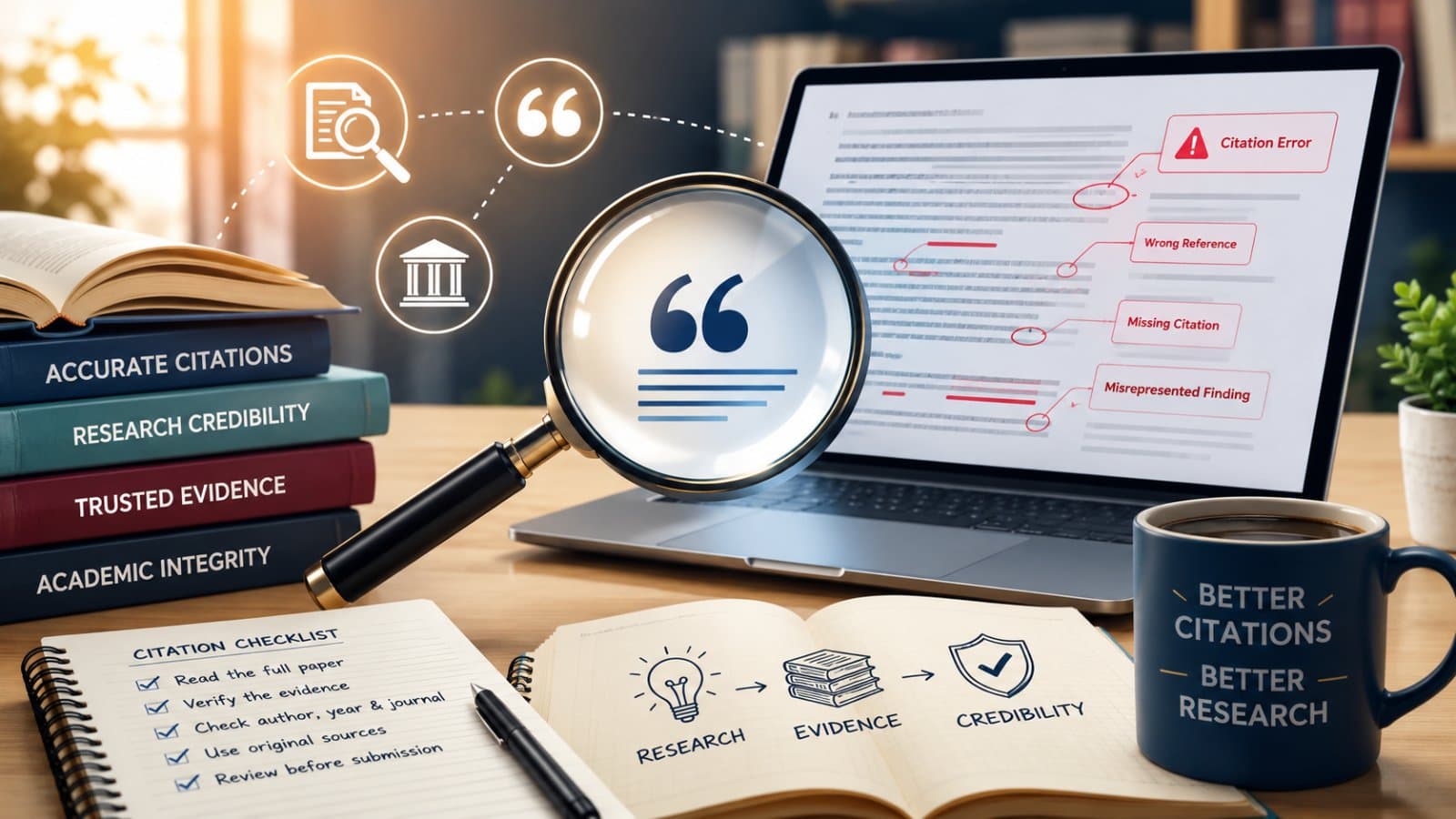
“What if one incorrect citation made readers question your entire research paper?”
Research papers require time to complete. Research requires months of review of literature, data collection, analysis of findings, and formulation of arguments. However, sometimes, an error in the references section can cause even greater trouble by making readers start doubting the academic credibility of the paper.
Inaccurate citations, omission of sources, misrepresentation of findings, and other similar errors can damage the link between claims and the facts that support them.
That is why research paper citation is not only the process of applying certain citation styles like APA, MLA, Vancouver, etc. It also means indicating the origin of the provided information and gives a reader the possibility to verify the provided evidence.
Citation errors may sometimes be unintentional. They can be caused by lack of time, difficulties in getting full-text papers, or just negligence. But even an unintentional mistake may influence the opinion of the readers concerning your research.
This guide explains the most common citation problems, why they matter, and how researchers can check their sources before submitting a manuscript.
Why Citations Matter in Research
It is difficult in case of research to be done starting from scratch. Research is based on information that others before you have researched.
Citations are useful because they establish this connection between your work and the knowledge of others. They inform the reader about where your information has come from.
This explains the importance of citations in research. A good citation does more than give credit. It helps readers understand the evidence behind your argument.
Good academic referencing helps you:
- Support claims with credible evidence.
- Acknowledge the researchers behind the primary research.
- Allow readers to trace your sources.
- Demonstrate the relevance of your research in relation to previous literature.
- Make your claims more verifiable.
Reliable research paper references therefore form an important part of a trustworthy research paper.
How Citation Errors Affect Research Paper Credibility
A citation does not automatically make a statement reliable. The cited source must actually support the statement being made.
For example, a researcher states that a certain study “proved” that the treatment works well. Actually, the study conducted earlier had proved positive results on only a few subjects. The citation may be accurate, however, its presentation is misleading.
This is where research paper citation errors become a research-quality issue.
Once a reader is aware of an inaccurate citation, they might begin to question the rest of the paper, research credibility, and its claims. Is the entire work of the author reliable?
Common effects of citation problems
| Citation problem | What can happen |
|---|---|
| Wrong reference | Readers cannot verify the claim properly. |
| Missing citation | An important statement appears unsupported. |
| Misrepresented finding | The original research may be given a different meaning. |
| Outdated evidence | The paper may not reflect current knowledge. |
| Incorrect author or year | Readers may have difficulty locating the source. |
Citation issues may also be propagated. In case researchers cite or interpret the findings of other papers without verifying them against the actual source, there may be issues with the accuracy of information. The supplied research material highlights how repeated citation errors can contribute to inaccuracies and misinformation in scientific literature.
The Most Common Citation Errors Researchers Make
Most citation mistakes are not made deliberately. They often happen during busy stages of research and manuscript preparation.
Here are some of the most common problems.
1. Citing a Paper Without Reading the Full Text
Imagine that you find a useful result in the abstract of a paper. You add the reference to your manuscript and continue writing.
Later, you read the full study and discover that the result applied only to a particular group or research condition.
The citation is currently being used without its complete context.
Abstracts are helpful when looking for studies that can be used, but not all abstracts will give sufficient detail on the methodology, limitations, and other elements of the research. It is suggested to review the whole paper before citing it.
2. Changing the Meaning of a Finding
Researchers may unintentionally make a finding sound stronger than it actually is.
For example:
| Less accurate | More accurate |
|---|---|
| “The study proved that the treatment works.” | “The study reported positive results in the study population.” |
| “The research shows the method always works.” | “The findings suggest that the method may work under the conditions studied.” |
This small difference can affect readers’ perceptions of the evidence.
In this regard, researchers need to report the findings as similar as possible to the findings obtained from the original study.
3. Using the Wrong Reference
A researcher may have several similar papers saved in a reference manager. During writing, the wrong source can accidentally be attached to a claim.
These incorrect citations can be hard to spot as the reference can seem real itself.
The most effective strategy for avoiding such an error is to verify that the source actually contains evidence used in the sentence.
4. Ignoring More Relevant or Recent Research
Researchers sometimes continue using familiar papers even when newer and more relevant studies are available.
This can happen when an older source already appears in several papers or is easier to find.
A strong literature review should consider relevant research rather than simply repeating references that other authors have used.
5. Relying Only on Secondary Sources
Review articles, books, and other secondary sources can be useful for understanding a topic. However, researchers should locate the original study when possible, particularly when discussing a specific research finding.
The supplied source recommends citing original research for discoveries and using additional literature to show whether findings remain relevant and supported.
What Causes Academic Referencing Errors?
Academic referencing errors can happen for many ordinary reasons.
A researcher might be dealing with tens or even hundreds of sources simultaneously. There could be some papers that would not easily available, while other papers could share similar titles and authors.
Common causes include:
- Limited time during manuscript preparation.
- Difficulty accessing full-text articles.
- Relying on abstracts instead of complete papers.
- Copying references from another paper.
- Poor reference organization.
- Limited training in citation practices.
- Failing to check references before submission.
The source material also identifies author-related, article-related, journal-related, and guideline-related factors that can contribute to citation problems.
Understanding these causes can help researchers develop better checking habits.
A Simple Citation Verification Process
Before submitting your manuscript, take a few minutes to check your important references.
Research Paper Citation Verification Flow
Read the full source
↓
Find the exact evidence supporting your claim
↓
Compare your wording with the original finding
↓
Check author, year, journal, and other details
↓
Confirm that you have used the correct source
↓
Ask a co-author to review important citations
↓
Complete the final reference check
This process is simple, but it can catch many problems before your paper reaches reviewers.
Best Practices for Accurate Citations
Good, accurate citations depend on careful checking. Reference software can help with organization, but researchers still need to verify the sources themselves.
Use this quick checklist:
| Before submission | What to check |
|---|---|
| Read the source | Do I understand the study and its findings? |
| Check the claim | Does the source support my exact statement? |
| Check the interpretation | Have I changed the meaning of the original finding? |
| Check the source type | Should I use the original study? |
| Check publication details | Are the author, year, title, and journal correct? |
| Check recent evidence | Are there newer relevant studies? |
| Get a second review | Can a co-author check important references? |
This improves reference accuracy and makes it easier for readers to verify your work.
The source also recommends having another author verify citations and calls for clearer guidance and training in good citation practices.
Citation Accuracy Across Different Research Fields
Citation requirements differ between disciplines, but the need for citation accuracy remains important.
Scientific and Medical Research
Scientists need to examine the original studies while referring to the outcomes of experiments. In the case of medicine, citing references is particularly crucial since the wrong description of evidence can mislead readers.
Legal Research
The importance of citation in legal research becomes even more evident as many legal arguments rely on specific citations to legal cases, laws, regulations, and other sources of law.
The mistake made in the citation may mislead the readers to the wrong authority or make an argument difficult to verify.
Social Sciences and Humanities
Sources include journal articles, books, reports, documents from history, interviews, and many more. Accurate referencing will make it possible for the reader to separate what is documented from what is personal to the researcher.
Can Reference Management Software Prevent Citation Problems?
Tools that can make reference management much easier are:
- EndNote
- Zotero
- RefWorks
- Mendeley
They can help researchers:
- Store reference information.
- Organize sources.
- Insert citations while writing.
- Create reference lists.
- Change citation styles.
- Reduce some formatting errors.
However, software cannot determine whether a source actually supports your argument.
A reference can be perfectly formatted and still be the wrong reference.
Researchers therefore need to check both the bibliographic details and the evidence behind each important citation. The source specifically notes that technical citation errors can be reduced through systematic organization and reference-management software.
What Should You Check Before Submission?
Before submitting your research paper, ask yourself:
- Have I read the important sources I cited?
- Does every major claim have appropriate evidence?
- Does each reference support the statement beside it?
- Have I avoided unnecessary citations?
- Have I checked whether newer relevant studies exist?
- Are the author names, publication years, and journal details correct?
- Have I checked important references with a co-author?
These questions can help identify problems before a reviewer or reader finds them.
Final Thoughts
Each citation serves as a connection between the research conducted and the evidence that exists prior to this research.
In case the connection is correct, the reader is able to trace the author’s logic and check whether his claims are based on reliable sources. In case the connection is wrong, the reliability of the paper may be compromised.
It is thus clear that proper research paper citation is important for much more than just your reference page. It helps to preserve the credibility of the research you are doing.
The objective is not merely to cite a large number of references. The objective is to have the right references supporting the right claims.
Quality research is characterized by good evidence, sound logic and fair reporting. The verification of sources is just one of many aspects of the process.
In research, credibility is built one carefully verified source at a time.
Frequently Asked Questions
Why is research paper citation important?
Research paper citation gives credit to original authors, supports important claims, helps readers verify evidence, and makes academic research more transparent, trustworthy, and easier to evaluate.
What are the most common citation mistakes?
Common citation mistakes include missing sources, wrong references, inaccurate publication details, misrepresented findings, outdated evidence, and citing studies without checking their relevance.
How can researchers improve citation accuracy?
Researchers can improve citation accuracy by reading full sources, matching claims with evidence, checking publication details, using reference software, and reviewing important citations before submission.
Why should researchers avoid relying only on secondary sources?
Secondary sources can summarize or interpret original findings. Checking primary research helps researchers understand the evidence directly and reduces the risk of repeating inaccurate interpretations.
Can research paper citation errors affect publication?
Yes. Citation errors can weaken arguments, reduce reviewer confidence, require manuscript corrections, delay publication, and make readers question the reliability of other claims in the research.