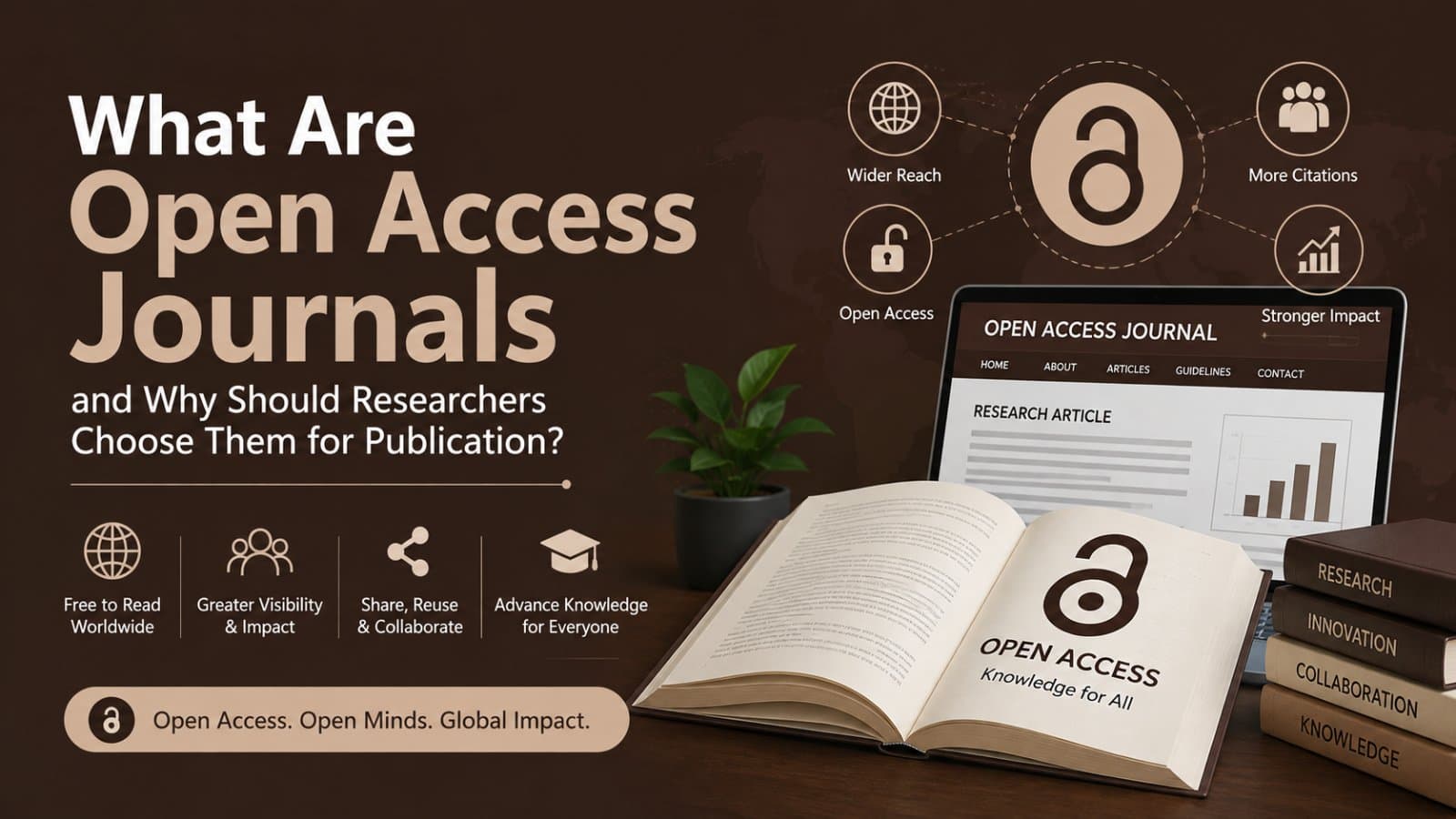
"Your research can be excellent, but if readers cannot access it, how far in reality does it create impact?"
It takes months and sometimes even years for researchers to gather data, analyse it, and write an article. However, it is not the end of their road; it is only the beginning.
The next question is: Who can actually read the research?
In a traditional subscription model, readers may need institutional access or payment to read the full article. Open access journals differ because they offer scholarly articles for free and usually allow users to reuse them through a license provided with the article. According to UNESCO, open access indicates that there should not be any economic, legal, and technical barriers to scholarly communication.
These differences are important for researchers who would like to disseminate their research results to the student community, academics, practitioners, policymakers, and readers from poorly funded institutions.
What Are Open Access Journals?
So, what is an open access journal?
Open access is when the scholarly content of a journal is accessible to its readers through the Internet. But a truly open-access system should also indicate the permissions for using the content by readers.
For instance, the Directory of Open Access Journals requires journals to offer unrestricted access and licensing through Creative Commons or an equivalent license.
It should be noted that having open access does not automatically make the journal a "low-quality" or "no peer review" publication. It may well be the opposite.
The key difference is how readers access the published article.
Subscription vs Open Access
| Feature | Subscription Journal | Open Access Journal |
|---|---|---|
| Reader access | Usually requires subscription/payment | Free online access |
| Paywall | Often present | Usually absent |
| Author licence | Depends on publisher | Often an open licence |
| Funding model | Mainly subscriptions | APCs, institutional support, grants, or other models |
| Global readership | Can be restricted by access | Potentially much broader |
| Reuse rights | Often restricted | Usually defined by an open licence |
How Does Open Access Publishing Work?
Funding models for Open access publishing exist in many forms. It is necessary not to fall into the trap of assuming that all open access publications must have an Article Processing Charge (APC).
UNESCO mentions some funding models, including Gold, Green, and Diamond Open Access.
1. Gold Open Access
The final article is made freely available on the publisher's website immediately after publication.
Some Gold journals charge an APC, while others do not.
2. Green Open Access
The author deposits an eligible version of the manuscript in a repository. Depending on the publisher's policy, an embargo may apply.
3. Diamond Open Access
Neither the reader nor the author pays a publication fee. The journal is supported through institutions, scholarly societies, consortia, public funding, or other infrastructure.
4. Hybrid Open Access
A subscription journal allows individual articles to become open access, usually when an author or funder pays an APC.
| Route | Reader Pays? | Author May Pay? | Where Article Is Available? |
|---|---|---|---|
| Gold | No | Sometimes | Publisher website |
| Green | No for repository copy | Usually no OA fee | Repository |
| Diamond | No | No | Publisher/platform |
| Hybrid | No for OA article | Often | Subscription journal website |
Important: Free-to-read does not automatically mean fully open access. Licensing and reuse rights matter too. DOAJ specifically distinguishes genuine open access from content that is merely free to read.
Why Should Researchers Choose Open Access Journals?
Let's consider two researchers who work on the same issue.
One researcher writes an article that is available to readers who belong to universities with subscriptions.
The other researcher writes his article using an open-access system.
A researcher from another country comes to know about this article via some search engine. A student uses the article in her thesis. A practitioner studies the results of the research. A researcher applies the methodology to his own study.
That is the central strength of open access: removing the reader-side access barrier.
Here are the most important reasons researchers may choose this route.
1. Your Research Can Reach More Readers
The most direct benefits of open access journals come from accessibility.
Readers do not have to belong to a university with an expensive subscription. This matters particularly for independent researchers, students, professionals, institutions with limited library budgets, and readers in regions where access to subscription databases is limited.
Research can therefore move beyond the walls of a particular institution.
2. Greater Potential for Research Visibility
With a freely available full article, there will be no subscription wall preventing the reader from opening, reading, downloading, and sharing it.
There has been evidence found in research conducted on open science linking open publishing to higher visibility, media coverage, chances for collaborations, and other types of scientific interaction.
There is something researchers must be careful about regarding a frequent misunderstanding:
Open access does not guarantee more citations.
Some research shows benefits in citations or usage rates, while others demonstrate that the result depends on the field, article category, journal, and methodology of the research itself.
3. Easier Sharing and Collaboration
A paper that readers can access without a paywall is easier to circulate among research groups and interdisciplinary teams.
This can help researchers:
- Discover related studies more easily
- Share papers with collaborators
- Compare methods and findings
- Build on previous research
- Reduce unnecessary duplication
- Connect with researchers outside their immediate field
Open access is therefore closely connected with the wider idea of open access research, where knowledge is designed to circulate more freely.
4. Research Can Reach Beyond Academia
Not every research user is a university professor.
Depending on the field, published findings may also matter to:
- Policymakers
- Healthcare professionals
- Teachers
- NGOs
- Industry professionals
- Independent researchers
- Students
- Journalists
- Members of the public
Open access ensures that these readers have access to the actual research rather than just the abstracts or summaries of the findings.
UNESCO recognizes open access as a key component of greater dissemination of information and science cooperation across the globe.
What Makes a Good Open Access Journal?
Choosing an open-access journal should not be based simply on whether the article is free to read.
A researcher should evaluate the journal itself.
Use this checklist:
| Check | What to Look For |
|---|---|
| Peer review | Clear and credible peer-review process |
| Editorial board | Real, identifiable subject experts |
| ISSN | Valid journal identification |
| DOI | Persistent identifiers for published articles |
| Indexing | Verify claims directly in the relevant database |
| Licensing | Clear Creative Commons or equivalent licence |
| APC | Transparent fees and waiver information |
| Ethics | Publication ethics and misconduct policies |
| Archiving | A clear long-term preservation strategy |
| Publisher | Transparent contact details and ownership |
| Website | Professional, consistent, and informative |
Remember: An ISSN, DOI, or attractive website does not by itself prove journal quality.
Open Access Is Not the Same as "Pay to Publish"
One of the biggest misunderstandings surrounding open access publication is that every author must pay.
That is incorrect.
Some journals charge APCs. Others are supported by universities, societies, research organisations, grants, or other funding mechanisms. Diamond Open Access specifically provides access without fees for readers and authors.
Before submitting, check:
- Is there an APC?
- When is it charged?
- Are waivers available?
- Are there additional editorial or submission fees?
- What exactly does the fee cover?
- Does the journal clearly explain its funding model?
A transparent fee policy is an important sign of responsible publishing.
How to Choose an Open Access Journal for Your Paper
If you are wondering how to publish in open access journals, start with the journal—not the payment page.
Follow this flow:

This process prevents a common mistake: choosing a journal simply because it promises fast publication.
A Quick Look at the Open Access Advantage
The growth of open access is not simply a publishing trend. It reflects a broader shift toward making research more accessible.
One large-scale analysis of journal literature estimated that 31% of journal articles were available as open access in 2019, while approximately 52% of article views were to open-access articles. The same study projected that OA availability could reach 44% of articles by 2025, although that projection should not be treated as a current measurement.

Source: OpenAlex/OurResearch analysis; 2025 figures are projections from the study, not current observed values.
What does this tell researchers?
Access is becoming an increasingly important part of how scholarly work is discovered, read, and shared.
Advantages and Limitations: A Balanced View
The advantage of open access journals is clear: readers can access research without a subscription barrier.
But researchers should also understand the limitations.
Advantages
- Wider potential readership
- Easier article sharing
- Greater accessibility across institutions and countries
- Potential for broader collaboration
- Easier public and professional access
- Supports wider knowledge dissemination
Limitations
- Some journals charge substantial APCs
- Waiver policies differ
- Predatory journals exist
- Open access does not guarantee high quality
- Open access does not guarantee citations
- Licensing conditions vary
In other words, open does not automatically mean good.
An honest journal requires editorial excellence, proper peer review, clear policy statements, and good publishing practices. It's important to recognize that accessible research does not replace quality research.
Why Open Access Matters for the Future of Research
Research takes on value only when it is discoverable, comprehensible, assessable, and usable.
This is how open access research papers may contribute to the dissemination of knowledge in academia.
Open access also fits within the broader movement toward open science. UNESCO describes open science as a wider framework that includes open scientific knowledge, open infrastructure, communication, engagement, and collaboration.
For researchers, the decision is therefore not simply:
"Should I publish for free or pay to publish?"
The better question is:
"Which publishing model gives my research the right balance of quality, accessibility, rights, cost, and scholarly reach?"
For many researchers, open access journal publication can be a strong answer—provided the journal is carefully evaluated before submission.
Final Takeaway
Open access journals offer an opportunity to reach a wider audience since they eliminate those barriers that hinder access to scientific literature.
Accessibility should not be the sole selection criterion, though.
Before submitting, check the journal's:
- Peer-review process
- Editorial board
- Scope
- Indexing
- Licensing
- APC and waiver policy
- Publication ethics
- Archiving arrangements
- Publisher transparency
The strongest choice is not simply the journal that publishes fastest or charges the least.
It is the journal that combines credible scholarly standards with meaningful access to research.
FAQs
1. What is an open access journal?
Open access journals are those that publish research papers in an open manner on the Internet so that people can access them without having any kind of subscription or payment.
2. Do open access journals always charge authors?
Not all do so. Some impose costs for article processing, while some are funded by organizations or grants.
3. Are open access journals peer reviewed?
Though peer review is common practice for many open access journals, it is important to check each journal's peer-review policy.
4. Does open access guarantee more citations?
No. Open access might help improve readership and visibility; however, there may be different citation impacts on various disciplines, journals, articles, and research methodologies.
5. How can researchers identify a trustworthy open access journal?
Check its scope, editorial board, peer review system, indexing claims, licensing, costs, ethical policies, archiving, publisher details, and publication history.